Textile knowledge · Linen care
What GOTS Certification Tells You About Organic Linen Bedding
A label can make a piece of bedding seem legible: organic, natural, responsibly made. But the words do not all mean the same thing, and a fibre claim alone says little about what happened after the crop left the field. GOTS certification offers a wider view, following qualifying textiles through defined stages of processing and manufacture. Understanding its scope makes it easier to read labels carefully—and to see what a certificate does not promise.
Linen has a way of seeming straightforward. It begins as flax, a plant cultivated for its fibres, and ends as cloth with a recognisable texture: cool to the touch, breathable, and inclined to soften with use. Yet the route from field to finished sheet is not a single act. It may involve harvesting, fibre preparation, spinning, weaving, dyeing, finishing, cutting and sewing. Each stage has its own materials, processes and potential environmental effects.
That long route is why the word organic, on its own, can leave important questions unanswered. It may describe how a fibre was grown, but not necessarily how the yarn was dyed, how a fabric was finished, or whether the businesses handling it can document its origin. The Global Organic Textile Standard—usually shortened to GOTS—is designed to assess more of that textile chain than a bare claim about fibre content.
For anyone comparing organic linen bedding, the useful question is not simply, “Is it organic?” It is: what exactly has been certified, under which standard, and how does that claim relate to the particular sheet set in front of me?
What GOTS is intended to cover
GOTS is an international standard for textiles made with organic fibres. Its scope reaches beyond the agricultural origin of a fibre to include requirements for processing and manufacturing stages covered by the standard. In practical terms, this means that certification is not meant to describe only a flax crop or a bale of fibre; it addresses qualifying textile production and the documented chain through which materials and products pass.
The standard includes environmental requirements for textile processing, restrictions on certain chemical inputs, and social criteria for covered processing and manufacturing operations. It also requires records and verification intended to support traceability. These elements matter because textile production involves more than the visible cloth. Dyes, cleaning agents, finishes, wastewater management, working conditions and the movement of goods all belong to the larger story.
GOTS is a certification system, not a poetic synonym for “good.” A business does not make a product GOTS certified simply by using organic flax or by describing its process as responsible. Certification depends on assessment against the standard, and claims should be read in relation to the certified operation, product and applicable labelling rules. The logo is a prompt to investigate the claim, not a substitute for understanding it.
Standards can change as requirements are revised. For that reason, consumers who need precise or current details should consult GOTS’s own public guidance and certification information rather than relying on an old summary, a retailer’s shorthand or a label copied from another product.
Organic fibre is one part of the picture
GOTS labelling distinguishes between products according to their organic fibre content. Under the standard’s labelling framework, a product labelled “organic” generally has to meet a higher organic-fibre threshold than a product labelled “made with organic.” The familiar thresholds are at least 95 per cent organic fibres for the “organic” grade and at least 70 per cent for the “made with organic” grade, subject to the standard’s detailed conditions and rules about permitted remaining fibres.
These distinctions are easy to miss when a product page compresses a supply chain into a few words. “Organic linen” may refer to the flax fibre; “GOTS certified” signals a claim under a broader standard, but the exact label grade and certification scope still matter. A careful reader checks the actual product label and supporting information instead of assuming that every textile bearing the word organic has the same composition or has been assessed in the same way.
Fibre percentages also need context. A sheet might contain linen in its main fabric, while thread, trims, labels or other components follow different specifications. Standards set rules for how products and their components may be represented. When details are unclear, ask the seller which product is certified, what label grade applies, and whether the claim covers the finished item rather than only a material used somewhere in its construction.
This is not needless fussiness. A certification claim is most useful when it is specific enough to be checked. A clear answer should identify the item, the standard and the scope of the claim, rather than relying on an atmospheric phrase such as “eco-conscious” or “naturally clean.”
From flax field to finished sheet
Linen begins with flax, but the plant’s journey into bedding involves several transformations. Fibres are separated and prepared, spun into yarn and woven into cloth. The fabric may then be dyed, washed, softened or otherwise finished before it is cut and sewn. A claim about the cultivation of flax does not, by itself, explain the methods used in those later steps.
GOTS’s wider approach is relevant here. Its processing requirements address matters such as chemical inputs and wastewater, alongside other environmental controls within the standard’s scope. Its social criteria concern covered workplaces and manufacturing operations. Traceability requirements help link certified inputs and processes to the claims made about textile goods. These measures do not make the supply chain simple; they make parts of it more accountable and more open to verification.
Still, certification has boundaries. It does not mean that every impact of a product has been eliminated, or that every stage in the life of a sheet is environmentally neutral. It does not automatically tell you how far a finished item travelled, how long it will last in your home, how it was packaged, or what will happen to it when it is no longer usable. Nor should a certification mark be read as a universal guarantee about comfort, durability, allergy response or performance.
That distinction matters because sustainability is not a single property that can be switched on by a badge. It involves material choices, farming, manufacturing, transport, care and longevity. Certification can provide meaningful evidence about specified parts of production; it cannot compress every environmental question into one answer.
A practical example: organic linen sheets
Consider a set of organic linen sheets described as made from flax grown in France and woven in India at a GOTS-certified organic facility. That information gives a reader several distinct points to examine: the fibre is identified as flax, its growing origin is stated, the fabric’s manufacturing location is named, and the product is presented as GOTS certified. Each statement answers a different question. Together they offer more useful context than the word “natural” alone.
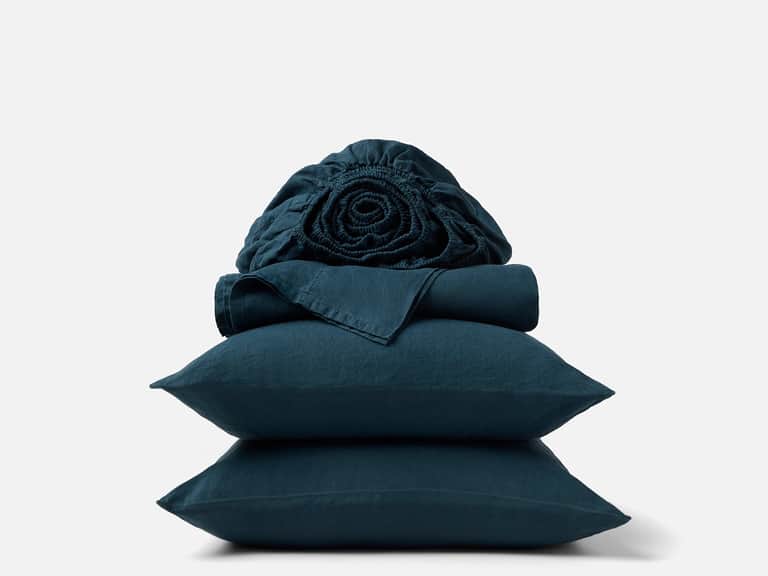
Naturepedic Organic Linen Sheets provide an example of how such details may appear in bedding information. The description identifies certified organic flax grown in France, manufacture in a GOTS-certified facility in India, a 185-gram-per-square-metre fabric, and a set that includes a flat sheet, fitted sheet and two pillowcases. It also gives care instructions. Those particulars help a reader assess material, construction, origin and routine maintenance separately, rather than treating a certification statement as the whole product story.
When assessing a claim of this kind, it is sensible to distinguish between a facility’s certification and a finished product’s applicable claim. A statement that manufacturing took place at a certified facility is useful, but it should not leave the product-level status ambiguous. Look for clear labelling on the item or its packaging, and ask the seller to clarify the certification scope when the listing does not do so. A certificate number or a reference that can be checked against reliable certification information may provide an additional route to verification.
Geographic origin is also worth reading precisely. “Flax grown in France” describes the crop’s origin; it does not mean that the fibre was spun, woven, dyed or sewn there. Those are separate steps and may take place in different countries. A transparent product description names those stages where it can. GOTS certification concerns the requirements and chain of custody within its scope; it is not a claim that every step happened in one place.
Questions that make a label more useful
When a bedding label or product description says “GOTS certified,” a few measured questions can turn a broad reassurance into information you can actually use:
- Which item is certified? Does the claim refer to the finished sheet set, the fabric, or a facility involved in production?
- What is the label grade? Is the product labelled “organic” or “made with organic,” and what does the relevant label say about fibre content?
- What are the fibres? Does the description specify linen, cotton or a blend, and does it provide percentages?
- What is known about the supply chain? Are growing, weaving and manufacturing locations identified separately rather than bundled into a vague origin claim?
- Can the claim be checked? Is there clear certification information or a reference that allows the claim to be verified through an appropriate source?
- What does the product information leave out? Consider care instructions, construction, expected use and durability alongside the certification claim.
These questions are not a test the shopper must pass before making a purchase. They are a way to keep claims in proportion. Good information is usually specific, consistent and comprehensible; it does not rely on a cloud of reassuring adjectives to hide a missing detail.
How GOTS differs from a simple organic claim
A simple claim that bedding contains organic fibre is principally a statement about material. Depending on the claim and the evidence behind it, it may tell you something about the fibre’s agricultural production. It may tell you much less about subsequent dyeing, finishing, manufacturing conditions or whether the movement of certified material can be documented.
GOTS is broader in that it sets requirements for eligible textile processing and manufacturing, not just the presence of organic fibre. It combines organic-fibre criteria with environmental and social requirements across covered stages, supported by inspection and traceability mechanisms. This does not make it a guarantee of perfection; it does make its scope meaningfully different from a generic, unsupported use of the word “organic.”
Other textile standards may address other questions, and one certification should not be mistaken for a complete comparison of every product attribute. A label may focus on chemical testing, fibre origin, workplace conditions or another defined concern. The first task is to understand what the standard actually assesses. The second is to see whether that assessment fits the question you care about.
Likewise, a high thread count, a soft finish or a particular country of manufacture cannot stand in for certification. Those details may matter to how a sheet feels or performs, but they answer different questions. A well-informed comparison keeps fibre, weave, weight, finishing, origin, certification and care in separate columns, so one attractive feature does not have to do the work of all the others.
Care is part of the textile’s life
Certification concerns production requirements; the life of bedding continues at home. Washing, drying and storage affect how a fabric feels and how long it remains useful. Linen is often valued for its breathable character and for becoming softer with use, but it is still a textile that benefits from sensible care. Always give precedence to the instructions supplied with the particular item, because fibre blends, dyes and finishing treatments can differ.
For the Naturepedic sheets described above, the care guidance is to machine wash warm, tumble dry low, warm iron if desired and avoid bleach. That is product-specific advice, not a universal rule for every linen sheet. Other linen bedding may call for a cold, gentle cycle or recommend different handling. A useful general habit is to avoid assuming that all “organic linen” behaves identically: check the care label, use a cycle suited to the item, and do not expose fabric to harsher treatment than its maker recommends.
Care also brings the idea of durability into the sustainability discussion. A well-made textile that remains in use can avoid being replaced quickly, although its actual lifespan depends on construction, use, washing and repair. A certification mark does not predict how long a sheet will last in a particular household. Practical details—seams, fit, fabric weight, laundering needs and whether the material suits the sleeper—remain important parts of an informed decision.
What certification cannot decide for you
It is tempting to ask a certificate to settle every argument about a product: whether it is the most sustainable option, whether it will feel comfortable, whether it is worth keeping for years. Those are questions GOTS is not designed to answer by itself. Its value lies in defined standards and verification, not in a promise that a product has no impact or suits every person.
Comfort remains individual. Linen’s texture may appeal to someone who likes a dry, lightly textured hand; another sleeper may prefer the smoothness of cotton sateen. Breathability is a material characteristic, but sleep comfort is shaped by room temperature, bedding layers, personal preference and other factors. Certification cannot tell you how a fabric will feel against your skin.
Nor does the word “organic” automatically settle questions about resource use, transport or end-of-life disposal. Those issues require evidence beyond the fibre label. A careful reader can recognise the real contribution of a standard while remaining curious about the parts outside its remit.
This balanced view is not cynicism. It is how standards become useful: by being taken seriously for what they cover, and not asked to claim what they do not.
Reading the label without losing the thread
Organic linen bedding brings together a plant fibre, a chain of textile processes and the ordinary intimacy of an object used every night. A GOTS claim can help make that chain more visible. It signals that the product is being represented within a standard that addresses organic fibre content and specified environmental, chemical, social and traceability requirements across covered stages of production.
The most reliable reading is neither dazzled nor dismissive. Check what is certified, distinguish “organic” from “made with organic,” look for product-specific information, and treat origin, comfort and care as separate parts of the decision. If a seller cannot explain whether certification applies to the finished bedding or only to an element of its manufacture, ask for clarification before relying on the claim.
A certificate cannot make a sheet feel softer, and it cannot erase the material footprint of textile production. What it can do is replace some vagueness with rules, documentation and verification. For a shopper standing between a persuasive phrase and a real object, that is a useful beginning: not the end of the inquiry, but a better place from which to make one.